

Latest article
Date |
03/09/25
Author |
Vicky Shedden
Topic(s) |
Blackface Sheep Breeders' Association
Corsebank

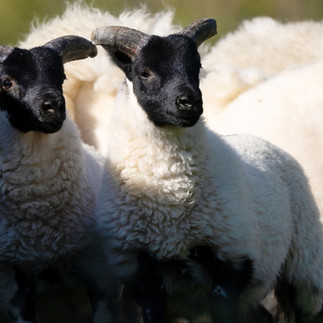


Focussing on strong commercial traits in their Blackface flock alongside an emphasis on health has led to some decent shearling prices over the last few years for the Renwick family at Corsebank, Sanquhar.
Iain farms 2300 acres in partnership with his parents, John and Liz, where they run 1100 Blackface ewes and 70 Limousin cross suckler cows with able assistance from long-serving shepherd, Craig Scott.
They admit to being a traditional Scottish hill farm but what they do, they do very well and the attention to detail and use of modern technology means their prime lambs and store cattle are much in demand with buyers.
One way or another the farm has been in the family since 1919, when John’s great uncle Jos Murray got the tenancy from Buccleuch Estates. When he died without an heir John’s father, Jim and his two brothers took on the tenancy, while keeping their home farm of Kirkhaugh at Alston, Cumbria.
Only Jim had family, so John inherited the tenancy and in 2006 he and Liz were given the opportunity to buy the 2100 acre unit as sitting tenants. Iain joined the partnership in 2017.
The family still own Kirkhaugh, which runs to 780 acres but last October they dispersed the stock and let it on a grazing licence to a neighbouring farm. Iain said, “It was just too far away and didn’t make economic sense for us to continue to farm it from our base here.”
Corsebank rises from 750 feet to 1600 feet above sea level, with only about 200 acres of steep, in-bye parks, so 51 acres of grass at Whitehill, about four miles away was purchased at the same time as the farm. This was followed in 2014 with 90 acres next door at Knockenstob and they rent a further 40 acres of grass all year round at Thornhill.
The farm has always been stocked with Blackies and John and Iain are passionate about them. Iain said, “I never cease to be amazed by the job they do on the hill. I love that a Blackface ewe can hold flesh, carry a lamb and nurse a lamb with very little help, but when she comes in to be checked, she still has that spark of character about her.”
Amazingly the only female sheep to be brought onto the farm in over 100 years was 26 years ago, when Iain was eight and his grandpa Kay at Gass gifted him an old ewe. She went on to breed a good tup lamb with a white flash which Iain sold as a shearling at Lanark for £350 and he has had the bug ever since.
After school, Iain worked for the Baillie’s at Calla for a year then did a degree in agriculture at Edinburgh before travelling to New Zealand for six months and returning home. He recently married Mairi McAllan MSP and they have a seven month old son, Somhairle.
Since buying the fields at Knockenstob, their favourite four crop ewes are tupped there and go on to have a further crop of lambs. This also means they have room to tup the Corsebank ewes in the hill parks from 25th November. The farm is deficient in cobalt, so they get a bolus before tupping and, before being turned out to their hefts at the end of the year, they receive a dose for fluke and trace minerals including copper and iodine. The combination of minerals and tupping on slightly better ground has seen more sets of twins but thanks to the extra fields, they can cope. This year the ewes scanned at 137per cent.
Ewes are not fed on the hill, but after scanning the thinner twins are brought into hill parks and fed from about six weeks prior to lambing. The rest of the twins come in a fortnight before, and the singles are lambed on the hill.
John said that one of the key aims is for a healthy flock, so they cull hard for lameness and yeld ewes and they also OPA scan. The most recent scan of 900 ewes showed only one positive. Alastair McArthur at Nunnerie has done a lot to promote OPA scanning and John and Iain reckon it is well worthwhile. Their tups are done two or three times a year, most significantly, just before the sales.
Apart from 320 ewe lambs retained as replacements and 35 of the best tup lambs kept, the rest of the lambs are finished, selling from October through to April. They get to good weights on the winter grazing the Renwicks take on a dairy farm. John buys in a further 200 Blackface lambs to finish. They are sold through Lawrie and Symington at Lanark where they had averaged £120 per head by the beginning of March with 500 still to sell.
John said, “We used to sell rough hoggs in June, but the strong fat trade has made this a more difficult decision. This year we will just keep about 100 to sell to our regular customers’’.
Because the bread and butter of the business is the prime lambs, both John and Iain like a big bodied sheep with a good shape, skin and colours and a leg at each corner, and this is the criteria they use to select rams both for sale and potential purchases.
They look for the fundamentals in a new stock tup first and something with an extra edge or character keeps the flock modern. Iain said, “We buy what we like and keep the gene pool wide. It seems to work for our system.’’
Around 15 to 20 home bred tup lambs are used every year and get the first chance at the ewes and about 20 shearlings are sold each year with the surplus used for chasing up. They said, “We use plenty of our own tup lambs to quickly get the genetics from our recent or best breeding stock tups onto the flock, it is also a bonus being able to sell proven shearlings.”
Two years ago, they were delighted to achieve their best price to date of £28,000 at Lanark for a shearling son of a £1000 South Cobbinshaw. He was sold in a three-way split to Hartside, Parkhall and Aikengall.
With Liz, Mairi and Somhairle all in attendance last year, the family was thrilled to achieve £12,000 at Lanark for one by a £6500 Dunruchan to Kirkstead and £11,000 for an £11,000 Dudlees son sold to Crosswoodhill.
They sell at Lanark, Stirling and Dalmally and had a good go at Stirling last year when they sold to £5200 and £4200 and averaged £1780 for ten shearlings. Iain said, “We work hard at producing sheep with the traits that buyers want just now, with the focus particularly on size, conformation and bare coats.” He uses social media to promote the livestock and often puts drone footage on the farm’s facebook page, Corsebank Blackface.
There is a long history of tup breeding at Corsebank; John pointed out that his father and uncle topped Lanark in 19facebook page a ram lamb named Ambition, which sold to Penchrise.
On the purchasing side, a £2600 Auldhouseburn by Bolt produced very consistent, good females, while more recently the Dudlees tup has done well. The progeny of a £5200 Dalblair is looking promising and they are excited about the future progeny of the £20,000 Allanfauld bought last year in a joint deal with Gass and Nunnerie.
John said, “We see selling tups as a bonus to the commercial side, but, if they do well, it allows us to re-invest in tups to produce good commercial lambs.”
Iain added, “We need the commercial side to be right as we can’t guarantee to always be able to produce tups the buyers want.”
Father and son are equally as passionate about their Limousin cross cattle. In fact, as they only use Limousin bulls and breed all their own replacements, most of the cows are almost pure Limousin now. They buy bulls on ease of calving ebv’s and like the breed because of the shape of the calves and the temperament of the cows.
Bulls are usually bought at Stirling with a couple of Dyke bulls doing well for them and a Maraiscote bull, but they also have five of their own pedigree females to breed their own back-up bulls.
Cows are in-wintered and calve inside from the beginning of March in a 12 week block before being turned out to the hill, where they make a great job of eating down the millenia grass, helping to improve the hill grazing for the sheep.
Calves are sold store at 18 months with steers averaging 520kg and heifers 480kg. Last October they averaged over £3/kg at Lanark with a top of £1800.
One cut of silage is made by contractors at Whitehill and Knockenstob to keep the cows and youngstock going over the winter.
Again, health is a priority, and the herd is in the Johnes health scheme where it has stayed at level one for several years now. They also vaccinate for clostridial diseases but are certified BVD free.
Enthusiasm for both the Blackface and Limousin breeds is what keeps the Renwicks going. They reckon they are also lucky in the Lanark and Peebles Branch area where they have lots of good friends and Iain laughed, “Lots of father/son combinations, who are all equally passionate about the breed and farming in general.” He said, “This area comes alive in the back end when we all get together for tup nights and get excited about the sales.”
With such a strong team of enthusiastic younger breeders coming through, particularly in this area, the future for the Blackface breed looks bright.